Pediatric Mobile Clinic Brings Care Directly to Miami-Dade Families
By meeting children in trusted community settings, the program removes financial, geographic and systemic barriers to care. Its community-based model puts public health into practice by shifting pediatric care from reactive to preventive.
During a routine examination aboard the University of Miami Pediatric Mobile Clinic, a provider detected a heart murmur in a child who previously had limited access to health care.
The team performed an electrocardiogram inside the mobile unit, had the results reviewed by a pediatric cardiologist and arranged a comprehensive specialty evaluation. Without the clinic, the condition might have remained undetected, or the family might have struggled to complete the necessary follow-up.
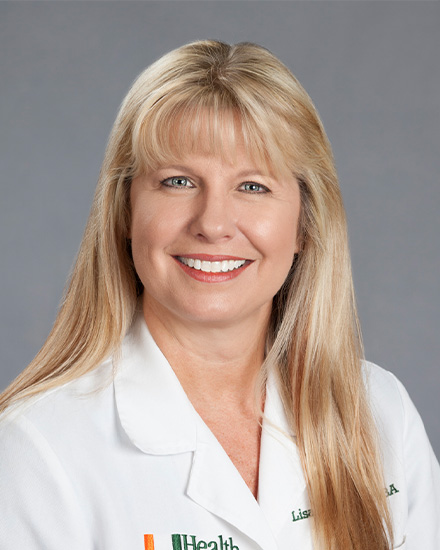
Lisa Gwynn, D.O., M.B.A., M.S.P.H., FAAP, is medical director of the Pediatric Mobile Clinic and School Health Programs, a professor of clinical pediatrics and public health sciences and associate chair for population health and advocacy at the University of Miami Miller School of Medicine.
Dr. Lisa Gwynn.
“We bring the health care system to the child,” Dr. Gwynn said. “We can identify a potential problem, begin the evaluation immediately, connect the child with the appropriate specialist and help the family navigate that process so care does not stop when the mobile unit drives away.”
A Medical Home on Wheels
The Pediatric Mobile Clinic serves more than 6,000 children annually through two mobile units and community-based sites across Miami-Dade County. Many of its patients are uninsured, have recently arrived in the United States or face significant barriers to accessing traditional pediatric care.
Eligible families receive services at no cost, regardless of insurance, immigration status or ability to pay.
The clinic provides comprehensive pediatric primary care, including well-child visits, immunizations, school and sports physicals, developmental and preventive screenings, treatment for acute illnesses and management of chronic conditions such as asthma.
It also provides behavioral and mental health services and helps families navigate specialty-care referrals, diagnostic services, insurance enrollment and community resources. Through the Miller School’s broader community pediatrics programs, children can also be connected with immunization services through initiatives such as Shotz-2-Go! and with other University of Miami and community-based resources when specialized care is needed.
“Our priority is not simply to provide episodic care,” Dr. Gwynn said. “We strive to serve as a medical home for uninsured and underserved children, providing continuity, preventive care and connections to the additional medical and social resources they need.”
The Pediatric Mobile Clinic was established in 1992 in response to the devastation caused by Hurricane Andrew. More than three decades later, the program continues adapting its services to address the changing needs of Miami-Dade families.
“The work of the Pediatric Mobile Clinic is both extraordinary and essential,” said Margie Jimenez, M.A., CRA, assistant chair of the department. “Dr. Gwynn and her team are not only expanding access to care; they are building the continuity and trust families need to keep children healthy. That sustained commitment is an invaluable service to Miami-Dade County.”
Removing More Than One Barrier
For many families, the barrier to pediatric care is not simply the availability of a physician. Transportation limitations, inflexible work schedules, language differences, lack of insurance and difficulty navigating the health care system can all prevent children from receiving timely care.
Recently arrived families may also be unfamiliar with the U.S. health care system or uncertain about where they can safely seek services.
From left: Aramis Martinez (driver), Maydelin Hernandez (nurse), Dr. Wendy DeLaRua (Lead Pediatrician), Silvina Montalvo (nurse).
The mobile units operate at locations families already know and trust, including churches, schools, community health organizations and sites serving immigrant families, agricultural workers and other vulnerable populations.
“Location matters enormously,” Dr. Gwynn said. “When health care is placed in a community where families already live, work, attend school, worship or receive other services, we eliminate one of the first barriers to care.”
Bringing services into the community also allows providers to catch children up on immunizations, identify developmental or behavioral health concerns and manage chronic illnesses before those needs become emergencies.
“That shifts care from being reactive to being preventive,” Dr. Gwynn said. “Our goal is to keep children healthy rather than waiting until they are sick enough to require an emergency department or hospitalization.”
Trust Makes the Model Work
Community partners do more than provide locations for the mobile units. They help identify children who need care, communicate with families and connect patients with services beyond health care.
“A mobile clinic cannot simply park in a neighborhood and expect families to come,” Dr. Gwynn said. “Trust is the infrastructure that makes this model work.”
The clinic visits community locations such as San Juan Bosco, Our Lady of Guadalupe, the Center for Haitian Studies and Good News Care Center in Homestead, in addition to schools and community events. Its team also works with organizations serving agricultural workers and other populations that may experience difficulty accessing conventional health services.
Connecting Clinical Care and Public Health
A three-time University of Miami graduate, Dr. Gwynn earned a B.S. in psychology, an M.B.A. in health sector management and policy and an M.S.P.H. from the University. Her multidisciplinary education and faculty affiliation with the Department of Public Health Sciences inform an approach that considers both the child receiving care and the broader conditions affecting pediatric health across Miami-Dade County.
“As a pediatrician, I care deeply about what happens to the individual child sitting in front of me,” she said. “Public health asks an additional question: Why are so many children experiencing the same barriers, and what can we change upstream?”
The clinic also serves as a training environment for pediatric residents and medical, nursing and public health students. Students gain experience caring for families in community settings while learning how insurance, geography, immigration, transportation and other social and structural factors influence health.
“The Pediatric Mobile Clinic provides our students with a unique opportunity to experience public health in practice,” said Viviana E. Horigian, M.D., M.H.A., vice chair for education and professor in the department. “Beyond learning about the social, environmental and structural factors that influence health, students engage directly with children and families in the communities where they live.”
“Through Dr. Gwynn’s leadership, the clinic fosters interdisciplinary collaboration and helps students understand how accessible, community-centered care can reduce barriers to health care and improve pediatric health outcomes,” Dr. Horigian added. “These hands-on experiences deepen their understanding of public health while preparing them to become compassionate, effective professionals committed to advancing health equity.”
The clinic plans to continue expanding its presence in South Miami-Dade County, strengthening the integration of behavioral health and primary care and using data to identify communities where children are not receiving needed services.
“Children do not choose the circumstances into which they are born,” Dr. Gwynn said. “When we provide preventive health care, vaccinations, developmental and mental health services and treatment when they are sick, we are doing much more than caring for an individual patient. We are giving that child a better opportunity to be healthy, attend school, learn and reach their potential.
“Investing in children’s health is an investment in the future of our entire community,” she added.
Families seeking the clinic’s current schedule or appointment information may call 305-243-6407.
Written by Deycha Torres Hernández, published September 2, 2026.