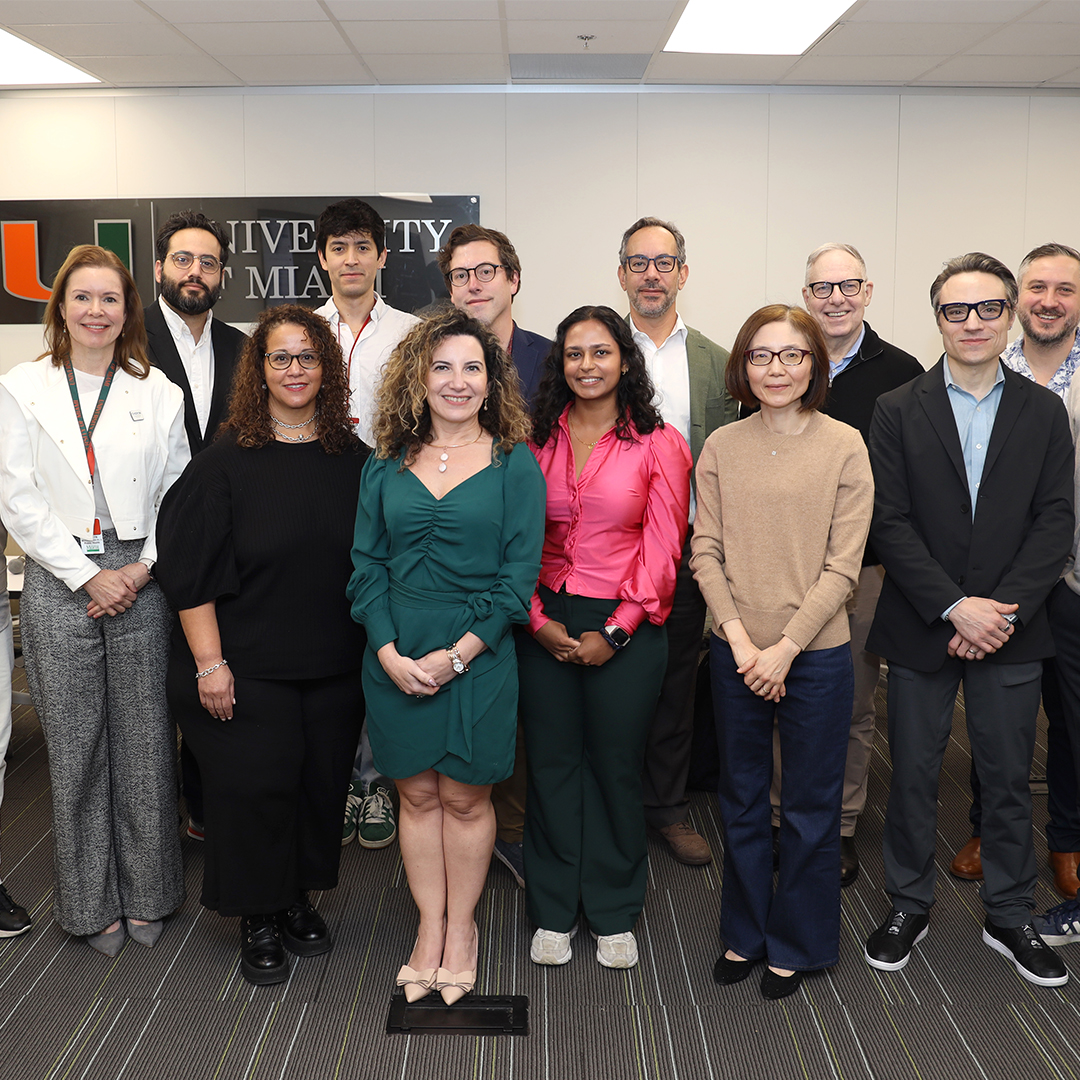
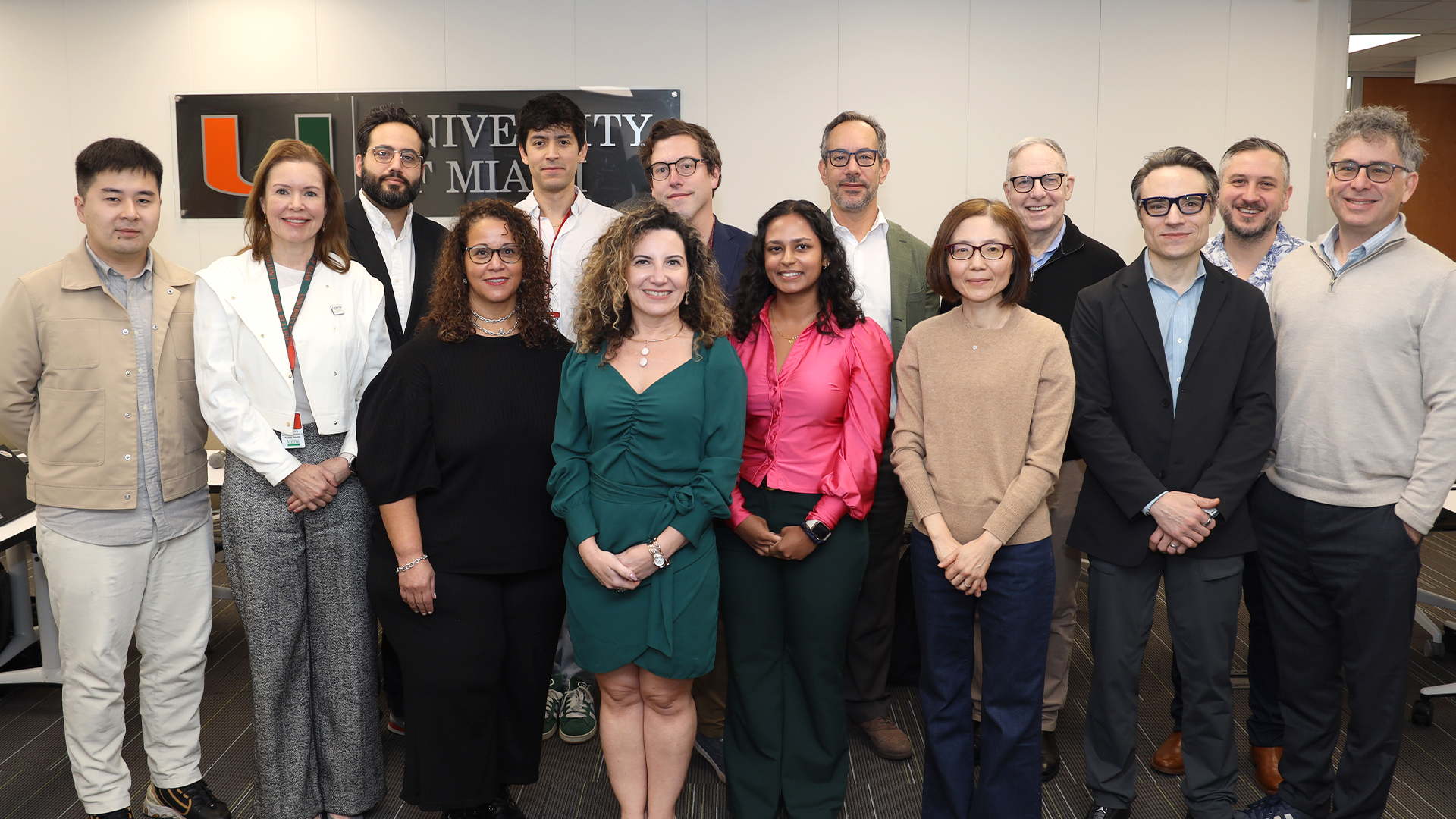
This year’s hybrid meeting featured a research seminar focused on social networks, HIV prevention, and substance use in South Florida.
The seminar was led by Mariano Kanamori, Ph.D., M.A., professor and director of the Division of Prevention Science and Community Health in the Department of Public Health Sciences at the University of Miami Miller School of Medicine, who presented findings from his work examining how social and geographic networks shape risk behaviors and prevention opportunities. Edda Rodriguez, Ph.D., M.P.H., research assistant professor, joined him.
Dr. Kanamori’s presentation demonstrated how network analysis can reveal patterns in sexual behavior, substance use, and uptake of HIV prevention strategies, including pre-exposure prophylaxis (PrEP). Using his NIH-funded spatially explicit social network model, which integrates dyadic, egocentric, sociocentric, and two-mode network approaches with spatial analysis, he showed substantial overlap between areas associated with sexual activity and drug use.
This intersection continues to challenge traditional prevention models. The findings point to persistent gaps in PrEP access and underscore the need for expanded services, particularly among uninsured communities in South Florida.
“By examining how social and geographic networks intersect, we can better understand where prevention efforts are falling short and where interventions like PrEP can have the greatest impact,” said Dr. Kanamori. “These patterns help identify opportunities to reach priority communities.”
The seminar also highlighted Dr. Kanamori’s innovative partnership with CVS Health pharmacies to support PrEP-focused randomized clinical trials using implementation science, demonstrating how collaborations with community-based organizations and corporations can effectively scale prevention interventions beyond traditional health care settings.
The research discussions took place as CHERISH enters its second renewal phase, following the award of a $10.9 million National Institute on Drug Abuse (NIDA) grant supporting years 11 through 15 of the Center’s lifespan. The five-year renewal will enable CHERISH to deepen cross-institutional collaborations, expand pilot projects, and strengthen the translation of evidence into practice, addressing the intersecting epidemics of substance use disorder, hepatitis C, and HIV.
During the leadership meeting, CHERISH investigators from New York, Boston, Philadelphia, and Miami reviewed progress across the Center’s five cores, including dissemination and policy, population data and modeling, pilot grant and training, methodology, and administration.
Kathryn McCollister, Ph.D., professor, director of the Division of Health Services Research and Policy, and interim chair of the Department of Public Health Sciences, directs the Methodology Core at the University of Miami.
Dr. McCollister outlined how the core supports economic evaluations of interventions targeting substance use, hepatitis C, and HIV, including cost-effectiveness, cost-benefit, and budget impact analyses. She emphasized the importance of rigorous data to inform decisions about sustainability and scale.
Methodology Core co-director Ali Jalali, Ph.D., of Weill Cornell Medicine, announced plans for a quarterly econometrics webinar series designed to advance methodological approaches for evaluating health interventions in clinical trial settings.
Across sessions, discussions focused on strengthening data infrastructure, improving evaluation methods, and ensuring that interventions developed through CHERISH are scalable, sustainable, and generalizable across settings. The meeting concluded with planning for upcoming conferences and scientific convenings in the substance use, hepatitis C, and HIV research communities.
“Economic evaluation is essential for determining whether promising interventions can be sustained and scaled in real-world settings,” said Dr. McCollister. “Our role is to ensure that decisions about HIV, hepatitis C, and substance use interventions are informed by rigorous data on both impact and cost.”
Together, the seminar and leadership discussions reinforced CHERISH’s role as a national hub for interdisciplinary research addressing overlapping public health crises and the importance of grounding prevention strategies in both social context and economic evidence.
Written by Deycha Torres Hernández, published on January 14, 2026.