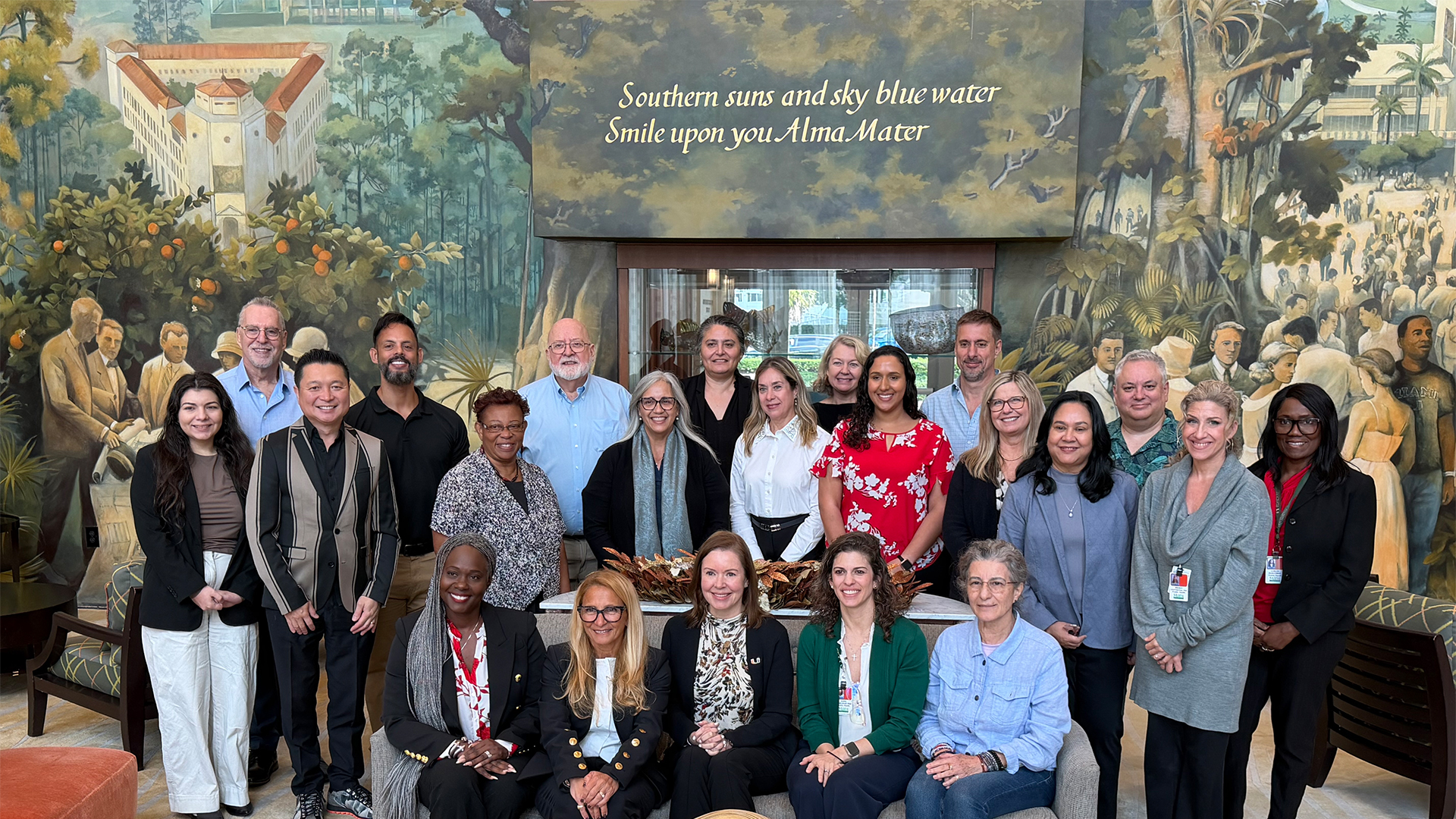
During the Department of Public Health Sciences’ Annual Faculty Teaching Retreat at the University of Miami Newman Alumni Center, faculty convened to examine how artificial intelligence is reshaping public health education and how educators can integrate emerging tools while maintaining disciplinary judgment and ethical responsibility.
The retreat centered on practical, ethical, and pedagogical questions surrounding AI, with an emphasis on strengthening faculty confidence while preserving human reasoning, disciplinary judgment, and community-centered teaching.
Understanding what AI can and cannot do
The retreat was organized by Viviana Horigian, M.D., M.H.A., professor, director of public health education, and vice chair of education, who framed the program around building shared AI literacy across the faculty, with a focus on responsible integration rather than technical specialization.
Shirin Shafazand, M.D., M.S., professor of clinical medicine, led the morning session, tracing the evolution of artificial intelligence from its origins in the 1950s to the development of contemporary large language models. She emphasized that while AI systems can replicate tasks associated with human cognition, they lack true understanding, ethical reasoning, and contextual judgment.
Her presentation addressed key limitations of AI, including bias, hallucinations, and the environmental costs associated with training large-scale models. Faculty also discussed legal and ethical considerations related to copyright, privacy, and student data, underscoring the need for instructional approaches that emphasize reasoning, dialogue, and critical evaluation.
Faculty examined the use of tools such as ChatGPT, NotebookLM, and Copilot as collaborative supports for teaching, with attention to clear instructional parameters and ongoing human oversight. Discussions highlighted prompt engineering as a practical strategy for clarifying learning objectives and guiding AI-supported activities, emphasizing the importance of defining roles, refining prompts iteratively, and maintaining alignment with educational values.
Designing Instruction with Human Judgment at the Center
In the afternoon, Caroline Fell Kurban, Ph.D., academic chief officer at the Academy of Active Learning at MEF, led an AI literacy workshop aligned with UNESCO’s AI Competency Framework for Teachers. The session emphasized instructional design principles that prioritize human reasoning before AI engagement.
Faculty participated in a hands-on exercise that involved reverse-engineering a student portfolio assignment to examine how AI can support learning while reinforcing ethical decision-making and pedagogical intent.
Expanding Our Human Connection
Interwoven throughout the day was a facilitated trust walk, Expanding Our Human Connection, which invited faculty to step away from screens and engage with one another through guided reflection and movement. The exercise reinforced a central theme of the retreat: that while AI may support efficiency and creativity, effective public health education remains grounded in relationships, judgment, and shared responsibility.
Faculty reflected on how collaboration, dialogue, mentorship, and trust continue to shape teaching practice, even as technology evolves.
The retreat concluded with a focus on developing a cohesive approach to AI that aligns with public health values and educational goals. Faculty identified practical ways to integrate AI into teaching while maintaining clarity about its limitations and the central role of human judgment and ethical reasoning.
Across discussions, participants emphasized that effective education in an AI-enabled environment depends on faculty guiding students to use these tools thoughtfully, critically, and in ways that support meaningful public health practice.
Written by Deycha Torres Hernández, published on January 21, 2026.