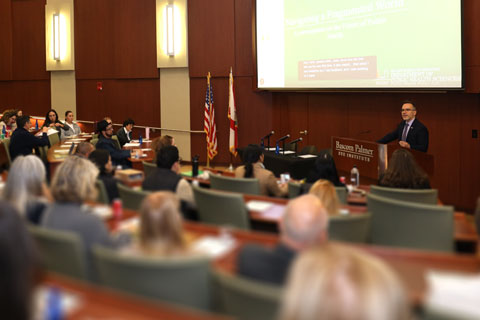
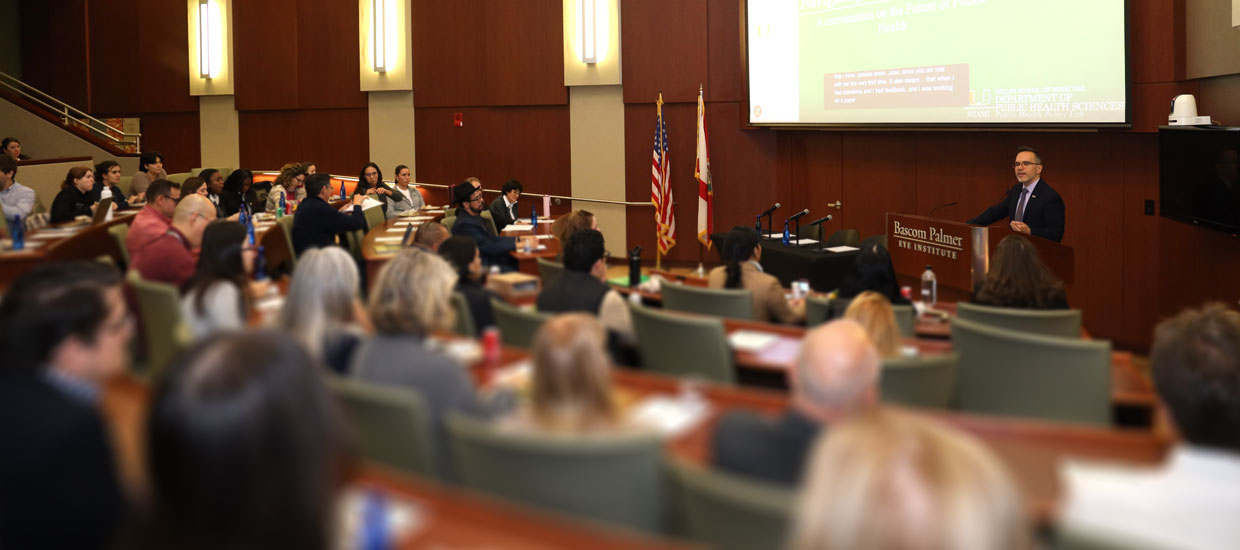
Hosted by the University of Miami Public Health Policy Lab, the event, “Navigating a Fragmented World: A Conversation on the Future of Public Health,” brought together experts to explore how public health can adapt and lead amid rapidly changing pressures.
The session featured José Szapocznik, Ph.D., chair emeritus of the Department of Public Health Sciences and founding honorary director of the Policy Lab; Jorge Saavedra, M.D., M.P.H., M.Sc., executive director of the AHF Global Public Health Institute; and moderator Ana Palacio, M.D., M.P.H., professor of clinical medicine and director of the Policy Lab.
Domestic Distrust and Shifting Public Expectations
Panelists began by addressing the erosion of trust in U.S. public health institutions. They noted that mistrust predates the COVID‑19 pandemic but was intensified by communication challenges, political polarization and competing societal values.
Beyond pandemic fatigue, speakers emphasized that individuals increasingly view public health guidance through the lens of personal autonomy, economic concerns or political identity. These tensions often place public health priorities at odds with the priorities of communities the field aims to serve.
One of the discussion’s recurring themes was the need to communicate more clearly and consistently.
“During the pandemic, part of the problem was our own communication as public health specialists,” Dr. Saavedra said. “We struggled to explain what the evidence supported and what it did not.”
Dr. Szapocznik added that rebuilding trust requires public health professionals to shift away from one‑size‑fits‑all messaging, and the importance of respecting the diverse beliefs and values that shaping how people interpret health guidance.
Communication, Cultural Competence and Reaching Across Divides
A significant portion of the discussion focused on cultural competence, not in the traditional clinical sense but as a communication framework for reaching people who hold different worldviews. Panelists stressed that public health must engage audiences with strong believes in individual autonomy (over collective well-being) by meeting them where they are, using language, messengers and narratives that resonate with their experiences.
Speakers outlined several practical strategies, including partnering with trusted community members, incorporating more behavioral and communication expertise into public health training and designing messages that respect value systems that prioritize collective well-being as well as individual autonomy.
Dr. Szapocznik emphasized this point, reflecting on lessons learned from early cultural competence research.
“To reach people, you have to meet them where they are and communicate in ways that resonate with their worldview,” he said.
Audience members added perspectives on the role of empathy, human connection and storytelling in restoring public trust. Participants noted that public health messages must be more relatable and accessible to counter misinformation and ensure communities feel seen and understood.
Global Fragmentation and the Need for Regional Solutions
The panel then shifted to global dynamics, exploring how reduced multilateral cooperation and geopolitical competition have created gaps in global health governance. Panelists described how many nations struggled during the pandemic as international supply chains collapsed and countries competed to obtain vaccines and supplies.
Dr. Saavedra highlighted the importance of strengthening regional public health institutions that can respond quickly to emerging threats. He discussed models such as CDC Africa and the growing support for a Latin American CDC‑like mechanism to enhance coordination across the region.
“Many global health emergencies begin regionally. Regional approaches allow countries to respond before a threat becomes global,” he said.
Speakers also noted that geopolitical shifts, including vaccine diplomacy by countries like China and Russia, underscored the need for sustained U.S. engagement in global health and renewed investment in public health infrastructure across the Americas.
Public Health Education and Workforce Needs
Panelists discussed the need to evolve public health education to incorporate communication, behavioral science and diplomacy alongside traditional epidemiology and biostatistics. These competencies, they said, are essential for engaging diverse communities, navigating political environments and addressing emerging global threats.
The conversation highlighted opportunities for the Policy Lab and the Miller School to support this evolution by fostering multidisciplinary training and strengthening partnerships across sectors.
Recognizing a Legacy of Leadership
At the conclusion of the panel, the event transitioned to a celebration of Dr. Szapocznik’s decades of service to the University of Miami and the global public health community. A recorded video message from Julio Frenk, M.D., Ph.D., former University of Miami president and current UCLA chancellor, honored Dr. Szapocznik’s role in strengthening global infectious disease preparedness and advancing prevention science.
The Public Health Policy Lab team presented Dr. Szapocznik with a commemorative plaque recognizing his “visionary leadership, heartfelt mentorship and enduring contributions to advancing global public health.” Representatives from the AHF Global Public Health Institute also presented a plaque acknowledging his collaboration and impact on global health governance initiatives.
Former mentees, including Willy Prado, former University of Miami Interim Provost, offered reflections on how Dr. Szapocznik shaped their professional paths, encouraged them to pursue doctoral training and championed transdisciplinary approaches that integrated communication, behavioral science and public health practice.
Dr. Szapocznik thanked colleagues and emphasized the potential of current students and early‑career professionals.
“This is a difficult time, but it’s also a moment of tremendous opportunity,” he said. “Public health must reinvent itself, and young people have a chance to create new paths for the future.”
A Continued Commitment to Public Health Leadership
Through this event, the Policy Lab reinforced its role as a forum for timely, solutions‑focused dialogue. Speakers agreed that despite an increasingly complex landscape, progress will depend on adaptive leadership, community engagement and strong regional cooperation. The conversation reflected a shared commitment to advancing public health in ways that are responsive, resilient and grounded in the realities of a fragmented world.
Written by Deycha Torres Hernández, published on February 13, 2026.