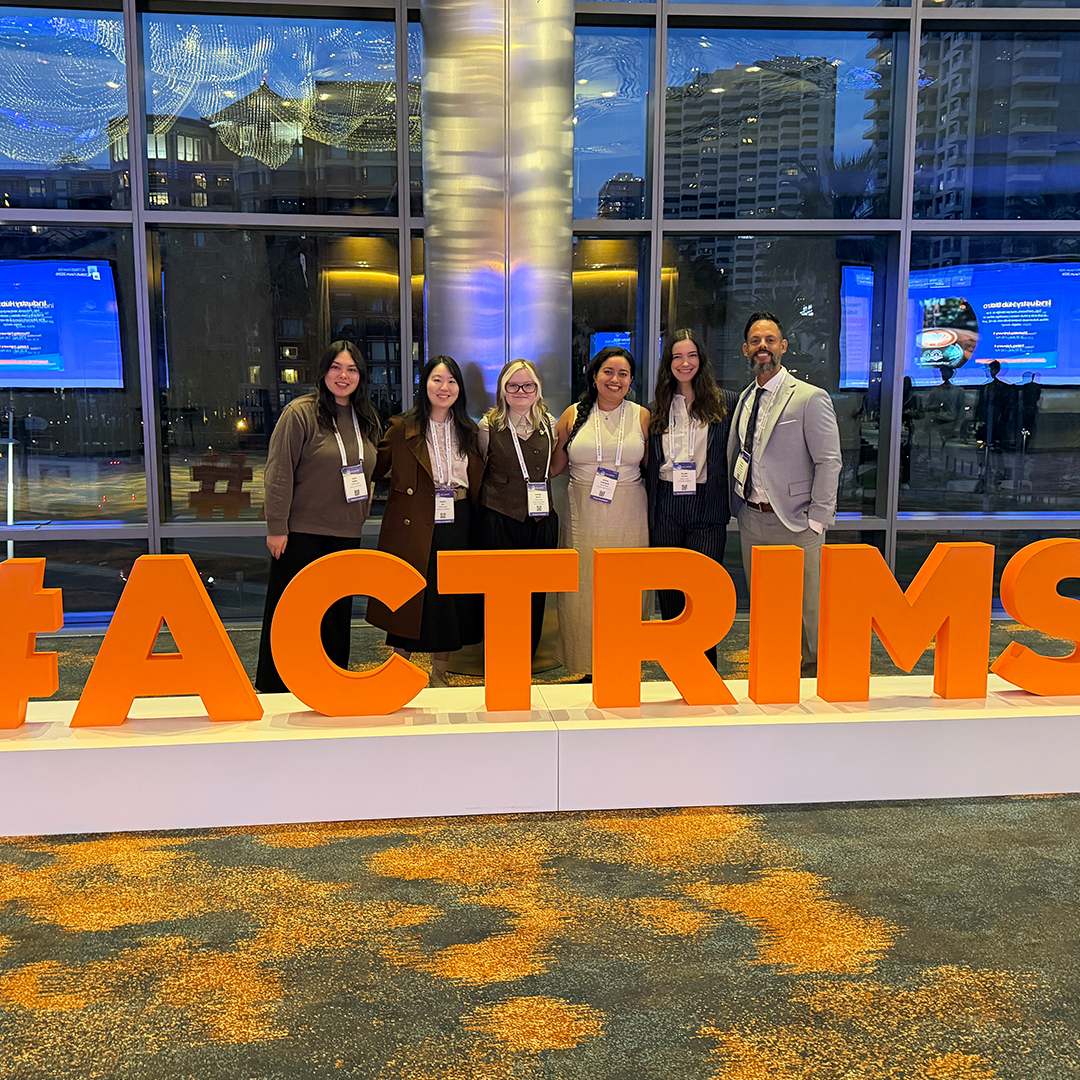
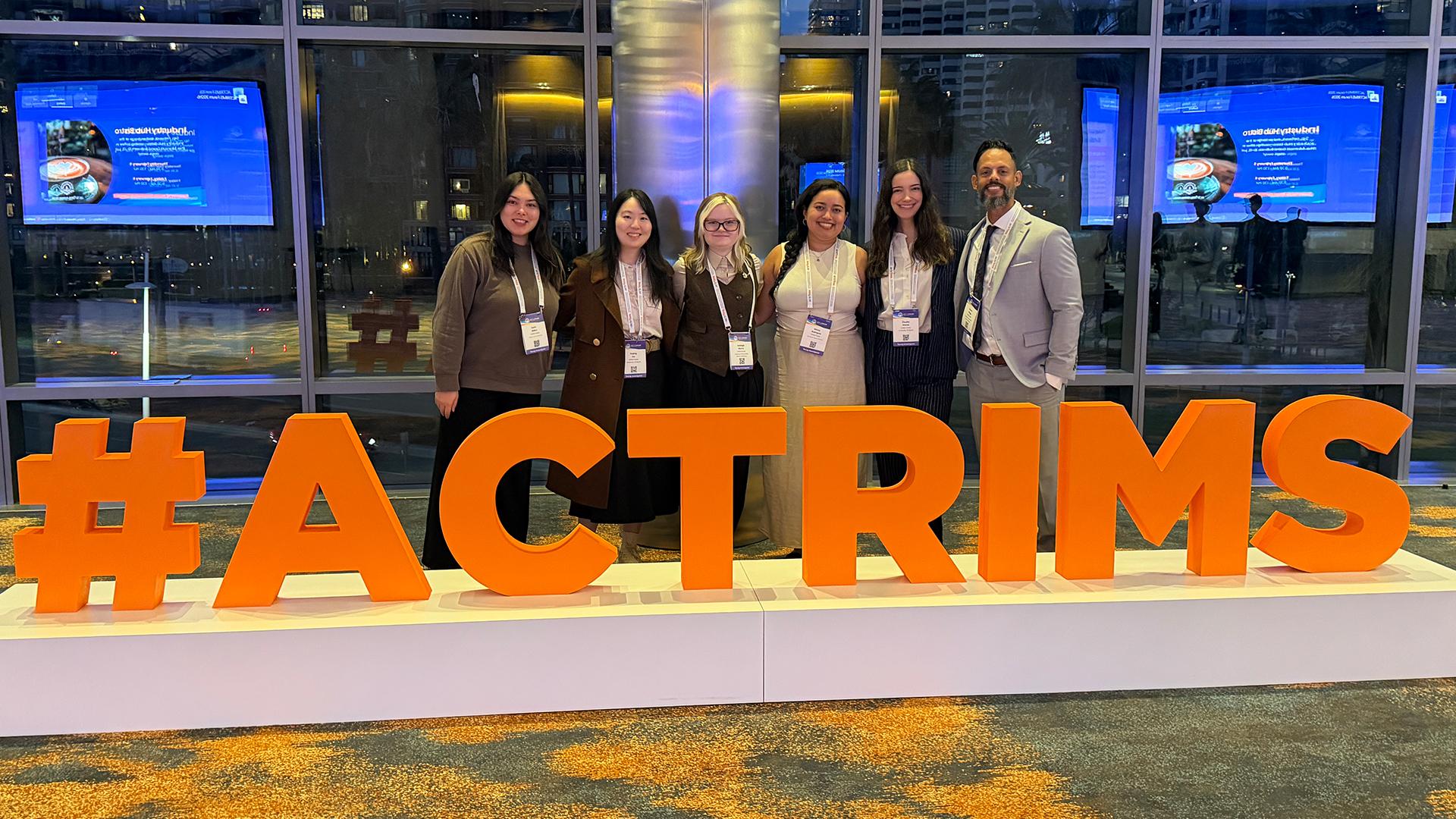
At this year’s Americas Committee for Treatment and Research in Multiple Sclerosis (ACTRIMS) Forum, epidemiology Ph.D. candidates Claudia Alonso, M.P.H., and Yuqing Liu, M.P.H., shared new findings that contribute to evolving conversations in MS science.
Alonso and Liu attended the conference with their mentor, Farren Briggs, Ph.D., Sc.M., associate professor in the Division of Epidemiology.
Dr. Briggs noted that ACTRIMS “convenes the MS clinical and research landscape in one setting, making it uniquely well‑sized for trainees like Claudia and Yuqing to connect with experts, understand their work within the context of the field, and build early collaborative networks.”
Examining MS Symptom Burden Over Time
Alonso presented her work, “Longitudinal Relationship of Cognition & Depression on Quality of Life in MS,” which examined how subjective cognitive impairment and depressive symptoms influence health‑related quality of life (HRQoL) over time. Her findings identified both factors as key drivers of HRQoL decline, with individuals reporting greater cognitive difficulties appearing particularly vulnerable to the compounding effects of depressive symptoms.
The results add nuance to MS epidemiology by showing how depressive symptom severity can intensify the already negative relationship between cognitive dysfunction and quality of life.
“ACTRIMS was an incredibly enriching experience. It’s exciting to share my research with professionals in other MS research disciplines, such as radiologists and statisticians,” Alonso said.
Biological Pathways Driving Early MS
Liu presented “Vitamin B6 Supplementation Associates with Lower Sphingosine-1-Phosphate and Altered Sphingolipid Pathways in Early Multiple Sclerosis,” a study examining how vitamin B6 supplementation relates to biological pathways involved in inflammation and immune signaling. She found that individuals who took B6 supplementation had lower levels of sphingosine‑1‑phosphate (S1P) and sphinganine‑1‑phosphate, two metabolites that play an important role in MS and are targeted by several MS medications.
The pattern suggests that vitamin B6 may activate a B6‑dependent enzyme that helps clear S1P from the body, offering early evidence that nutritional or biochemical factors may influence biomarkers linked to MS disease activity.
Liu received an ACTRIMS Young Investigator Education Grant for this work.
“I really appreciate the opportunity to present at the ACTRIMS conference, where I learned a lot about multiple sclerosis and also shared my research findings with physicians and statisticians,” Liu said.
Learning in a Multidisciplinary MS Environment
A key insight for both trainees was exposure to the field’s updated diagnostic framework, which moves away from traditional subtype labels and toward a model grounded in clinical disease activity and progression, including relapse‑associated worsening and progression independent of relapse activity.
Dr. Briggs emphasized that this shift highlights the growing need for robust, patient‑centered outcomes in MS clinical and observational research.
He also noted that presenting in a multidisciplinary environment “strengthens training by sharpening their ability to communicate across epidemiology, neurology, imaging, and immunology while understanding where their research fits along the spectrum of primary, secondary, and tertiary MS prevention.
Alonso and Liu will continue building on their discoveries, Alonso through dissertation work centered on patient‑reported outcomes and long‑term disease experience, and Liu through further study of metabolomic pathways that may illuminate mechanisms of MS progression and support future clinical and nutritional research.
Written by Deycha Torres Hernández, published on February 26, 2026.